insight
Clear Defaults


In commercial lighting design, efficiency is often reduced to lumens per watt. In practice, performance depends far more on how effectively light is delivered to the surfaces and tasks that matter. Asymmetric lighting addresses this gap by prioritizing directional control and optical precision rather than uniform distribution.
When paired with modern lighting control systems, asymmetric lighting can significantly improve visual comfort, reduce energy use, and deliver more consistent results across complex office environments.
The distinction between symmetric and asymmetric lighting lies in how luminous intensity is distributed relative to the luminaire’s optical axis.
Symmetric luminaires emit light evenly around a central axis, which simplifies layout and calculation. However, this uniformity often results in large portions of light being directed toward ceilings or peripheral areas where it contributes little to task performance. To compensate, designers frequently increase fixture density or output, reducing overall system efficiency.
Asymmetric luminaires, by contrast, are engineered to direct light toward specific target areas. Light is shaped and oriented to support work planes, circulation paths, and vertical surfaces, allowing required illuminance levels to be achieved with less wasted output. This approach improves the ratio of usable light to total emitted light, which is a more meaningful measure of efficiency in office applications.
Asymmetric lighting improves efficiency by increasing the utilization of luminous flux. Instead of illuminating the entire room volume uniformly, the system concentrates light where visual tasks occur. This targeted delivery reduces over-lighting and minimizes the need for excess wattage to meet illuminance requirements.
In many office installations, this results in lower lighting power density while maintaining or improving visual performance. The efficiency gains are not solely energy-related but also optical, as more of the emitted light contributes directly to usable illumination.

Glare control is a critical performance metric in office environments, particularly in spaces dominated by screen-based work. Symmetric lighting systems often place high-luminance sources directly within occupants’ fields of view, especially when ceiling heights are limited.
Asymmetric luminaires allow peak intensity to be oriented away from common sightlines. By controlling beam direction and cutoff angles, these systems reduce direct glare and improve Unified Glare Rating values. The result is a more comfortable visual environment that supports sustained focus without increasing overall brightness.
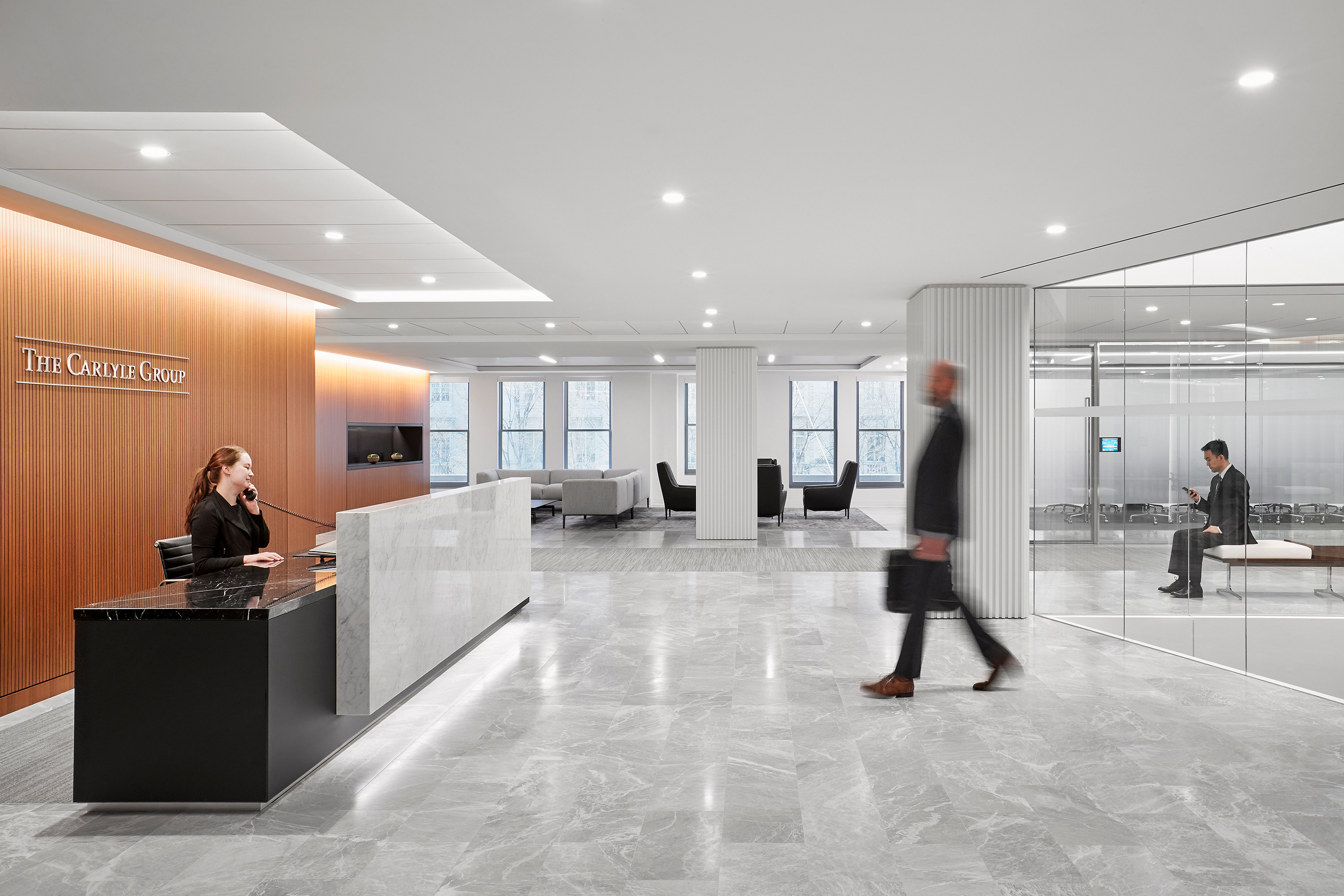
Office lighting performance cannot be evaluated solely on horizontal task planes. Vertical illuminance plays a significant role in spatial perception, communication, and visual comfort.
Asymmetric lighting is particularly effective at illuminating walls, whiteboards, and other vertical surfaces. This enhances contrast, improves facial recognition, and creates a sense of visual balance within the space. These benefits are often achieved without increasing total energy consumption, as light is redistributed rather than added.
Because asymmetric luminaires deliver light more precisely, they offer greater flexibility in layout and spacing. Designers can often achieve target illuminance levels with fewer fixtures, reducing ceiling clutter and simplifying installation.
This precision is especially valuable in renovation projects, where existing fixture locations may not align with current workspace layouts. Asymmetric lighting can correct these mismatches without requiring extensive structural changes, improving performance within existing constraints.
Directional optics alone do not guarantee consistent performance. To fully realize the benefits of asymmetric lighting, systems must be coordinated through centralized control.
Lighting control platforms such as COMPOSE enable asymmetric fixtures to operate as part of a unified system. By managing output levels, schedules, and zone behavior centrally, the platform ensures that performance remains consistent across spaces and over time. This orchestration reduces configuration drift and simplifies both commissioning and ongoing adjustment.

When asymmetric lighting is implemented within a coordinated control framework, organizations commonly observe reductions in installed wattage alongside improvements in visual comfort. Glare-related complaints decrease, task visibility improves, and lighting behavior becomes more predictable across different areas of the building.
These outcomes highlight the importance of designing lighting systems around performance rather than symmetry. Asymmetric lighting, supported by intelligent control, enables offices to deliver better visual results while using fewer resources.
Symmetric lighting has long been the default due to its simplicity. However, modern office environments demand higher precision and greater efficiency. Asymmetric lighting represents a shift toward performance-driven design, where light is delivered intentionally rather than uniformly.
When combined with system-level control platforms like COMPOSE, asymmetric lighting allows designers and facility teams to align optical performance with operational control. The result is a lighting system that performs better, adapts more easily, and remains efficient throughout its lifecycle.