insight
Clear Defaults


Color Rendering Index (CRI) describes how faithfully a light source reveals object colors compared with a reference illuminant (daylight or a blackbody) at the same CCT. The familiar CIE Ra score (0–100) is an average over a small set of test colors; the closer to 100, the closer the appearance to the reference.
Where CRI helps: quick screening for “reasonably accurate color.”
Where CRI breaks down: it can’t tell you if colors look duller or more vivid overall, and it hides hue-specific issues (e.g., skin looking flat, foliage looking artificial). Two sources with Ra 90 can render wood, stone, and skin very differently.
Don’t conflate CRI with CCT.
CCT is the appearance of the light (warm/neutral/cool). CRI is about how objects look under that light. Warm light can have poor CRI; cool light can have excellent CRI (and vice-versa).
CRI (CIE 13.3:1995) estimates average color fidelity with a single index Ra, computed from eight test-color samples (TCS01–TCS08) transformed into an older uniform space (CIE 1964 UVW* / CIE 1976 u′v′ family). For a test source with chromaticity adjusted to the reference CCT, each sample’s color difference ΔE is computed against the reference illuminant, and Ra is the arithmetic mean of the eight transformed fidelity scores (special indices R9–R14 are optional). Because the metric collapses behavior to a single average and uses a small, legacy sample set, it cannot quantify global saturation shift (gamut) or hue-localized deviations that strongly affect architectural materials. (CIE 13.3:1995).
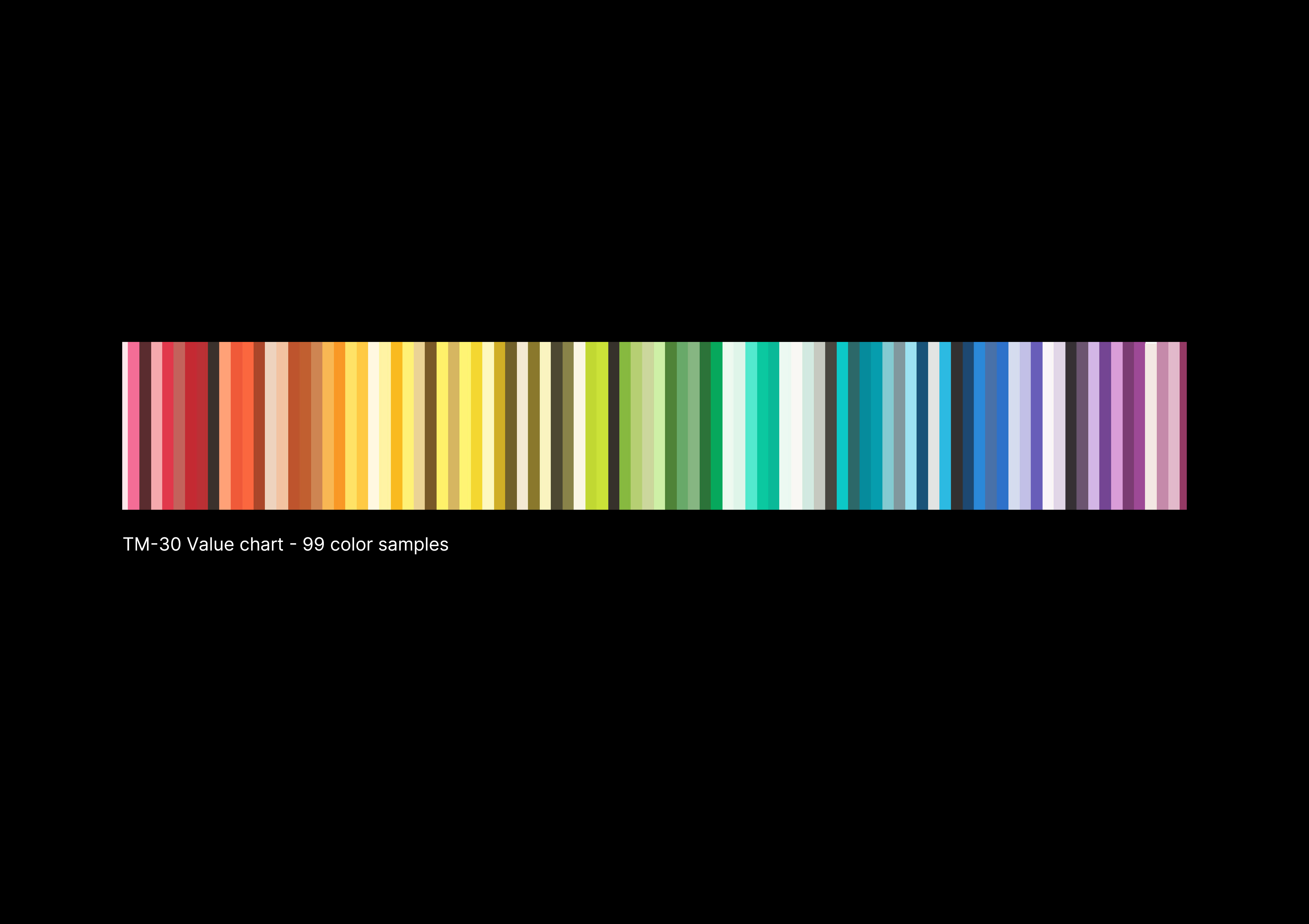
TM-30 (ANSI/IES TM-30-20) evaluates a test source’s spectral power distribution (SPD) against a reference at the same CCT over 99 Color Evaluation Samples (CES) in CAM02-UCS (J′a′b′). The method computes two global descriptors and standardized diagnostics:
Chromaticity/tint control is orthogonal but consequential. CCT positions the reference illuminant; Duv is the signed perpendicular distance from the Planckian locus in CIE u′v′ (CIE 1976). Small positive Duv appears greenish, negative appears pinkish; architectural practice typically constrains |Duv| ≲ 0.002 at operating setpoints to maintain neutral whites and stable material appearance. (CIE 224:2017)
Start from the headline pair (Rf/Rg) to bound global behavior, then interrogate CVG and the hue-bin table. Outward CVG bulges indicate added saturation in those hue sectors; inward vectors indicate desaturation. Confirm Rf,h1 (skin), Rf,h2–h4 (warm woods/leathers), Rf,h8–h9 (cyan/sky/glass), and Rf,h11–h12 (foliage) are consistent with design intent. Finally, verify CCT and Duv at the actual scene setpoints (including WarmDim and DALI-2 Type 8 tunable presets), because local chromatic adaptation and spectral channel mixing can change rendering at lower CCTs or dim levels. (ANSI/IES TM-30-20; CIE 224:2017)
For workplaces/education, hold Rf ≥ 90 and Rg ≈ 95–103 with Duv ≈ 0, prioritizing high local fidelity in skin and neutral substrates. Retail/hospitality often benefits from Rg ≈ 102–108 for controlled saturation “lift”; preserve Rf,h1 so faces remain natural. Healthcare programs typically maintain Rf ≥ 90, Rg ≈ 95–102, and tight Duv for clean whites and accurate skin. Museums/galleries push Rf higher with Rg ≈ 98–102 and rely on hue-bin checks near dominant pigments. Treat these as starting conditions derived from TM-30 constructs; accept or reject with finish-board mock-ups and captured TM-30 plots at the scenes you will commission. (ANSI/IES TM-30-20; DOE SSL tutorial)
Two concise checks to catch most failures
Spec clause (standards-aware snippet)
Provide luminaires whose white-light scenes meet ANSI/IES TM-30-20 average fidelity Rf ≥ 90 and average gamut Rg 95–105 at scheduled CCTs; maintain local fidelity Rf,h1 ≥ 90 (skin-tone bin). Constrain Duv to ±0.002 at full output and specified dim/tunable setpoints. Submittals shall include full TM-30 plots (CVG + hue-bin table) for each scene and re-verification at commissioning. (ANSI/IES TM-30-20; CIE 224:2017)
Sources (primary, technical)